 APEX OFFER
A clarification that adds rules the launch did not mention.
When Lark Funding launched 1-Step Max on 2 October, the reported rules were a 12% static drawdown, a 5% daily loss limit and no consistency rule, news restriction or minimum trading days. A condition for the free restarts mentioned risk per trade of 1%. The launch report did not mention a stop-loss requirement or a strike system.
On 6 October, Lark clarified how its risk limits and breaches work on 1-Step Max.
The risk limit and the breach system.
| Stage | What happens on a risk breach |
|---|---|
| Evaluation, breaches 1 and 2 | Soft breaches. Each brings a warning |
| Evaluation, breach 3 | A hard breach. The account is terminated |
| Funded account, first violation | A hard breach |
| Funded account, with the no-stop-loss add-on | The existing exception remains for traders who bought the add-on that allows trading without a stop loss |
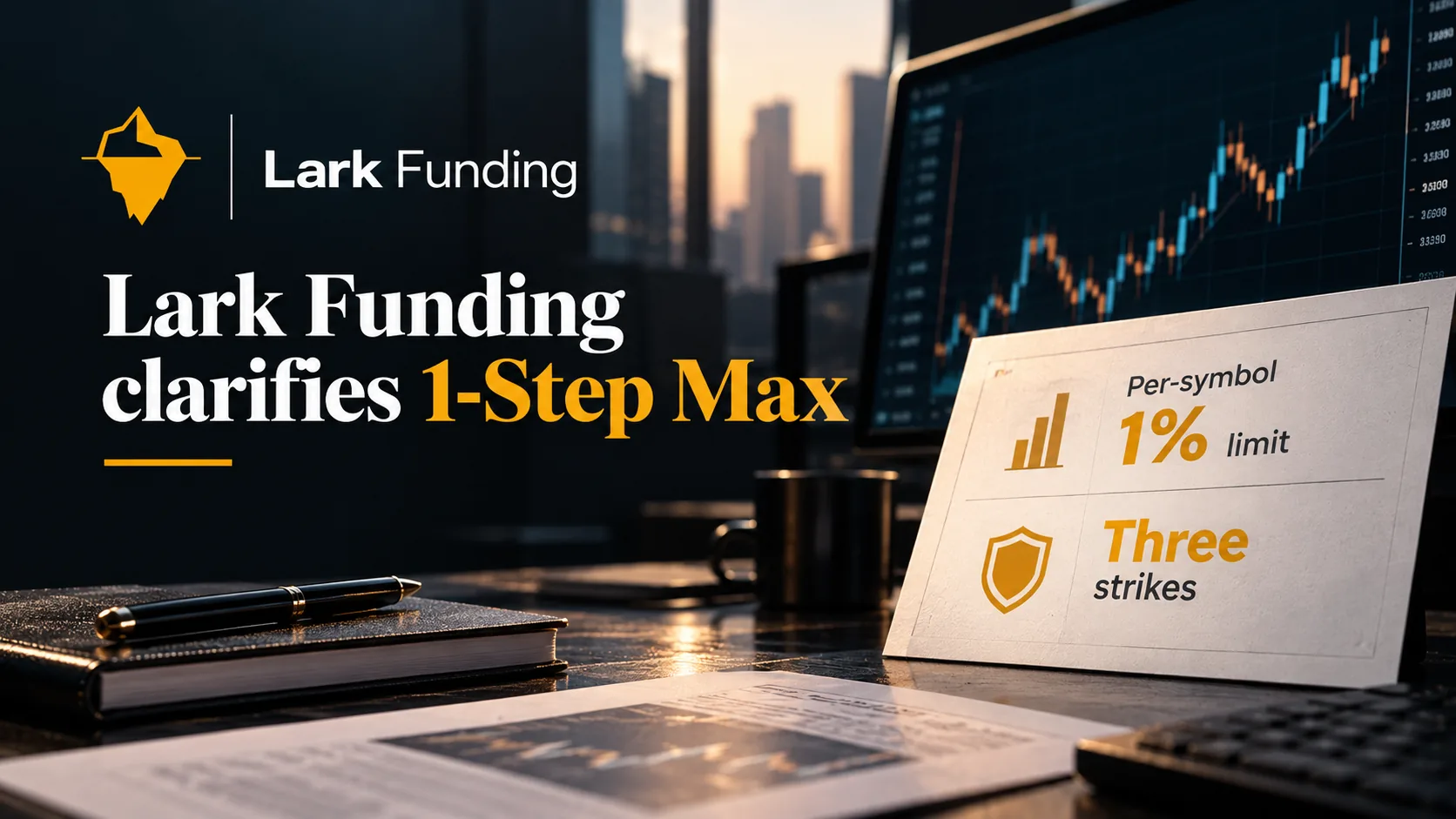
- ✓A 1% risk limit applies separately to each symbol, combining all open positions on that specific asset.
- ✓Positions across different symbols keep independent risk limits.
- ✓In evaluation, a shared counter tracks violations of symbol risk, missing stop losses and maximum position risk.
Details still missing.
- ✓What a soft breach does. Beyond a warning, the announcement does not say whether anything else happens, such as closing a position.
- ✓The counter. It is not stated whether the count resets, or how long a warning stays on the account.
- ✓How the 1% is measured. The announcement does not say whether it is measured against balance or equity, or at entry or while a position is open.
- ✓Maximum position risk. This is named as one of the counted violations, but its limit is not given.
- ✓The add-on. Its price, and how it interacts with the strike system, are not described.
- ✓Link to the restart rule. The 2 October launch said free restarts require risk per trade of no more than 1%. The new clarification suggests that is judged per symbol, but the announcement does not connect the two.
Fewer restrictions on paper, a real strike system in practice.
1-Step Max was presented as having no consistency rule, news restrictions or minimum trading days. The clarification shows it still enforces risk discipline, through a per-symbol 1% limit and a strike system that ends an evaluation on the third breach.
The funded-stage rule is stricter. One violation is enough for a hard breach, and the stop-loss requirement can only be avoided by buying an add-on. Traders who plan to scale into positions in one symbol should note that all open positions on that asset count together.
What to confirm.
Worth confirming directly with Lark Funding before buying: how the 1% is calculated, what a soft breach does, whether strikes reset, and what the no-stop-loss add-on costs.
If you prefer fewer breach rules.
Strike systems and per-symbol risk limits add rules to track. If you would rather compare against an established futures firm, it is worth looking at its published risk terms.
Our full Apex Trader Funding review covers the rules that matter and the ones that are mostly marketing. Code ONKAGNVZ applies up to 92% off evaluation fees during the current Apex sale.
 Start your evaluation →
See the current Apex discount for full terms before you buy.
What traders also ask.
- The Godfunded, "Lark Funding Clarifies Risk and Breach Rules for 1-Step Max Accounts", 6 October 2026.
- The Godfunded, "Lark Funding Launches 1-Step Max Program with 12% Static Drawdown", 2 October 2026.
DISCLOSURE: Trader Payout is an independent editorial site. Some links here are affiliate links, including for Apex Trader Funding, and we may earn a commission if you sign up. This does not affect our editorial choices, our data, or our verdicts. Futures trading carries substantial risk of loss and is not for everyone. This is general information, not financial, legal or investment advice. Confirm current terms directly with Lark Funding before acting.