 APEX OFFER

A policy change, and a separate pattern worth reading alongside it.
Lucid Trading, a futures prop firm, has confirmed directly on its own X account that new users flagged as high-risk will now complete KYC verification before they can purchase their first account, rather than waiting until their first payout request as under the firm's previous process.
The change is a real, substantive policy shift, and Lucid frames it plainly: an increase in "bad actors" is the stated reason. That framing is worth taking at face value on its own terms. It's also worth reading alongside a separate, independent pattern: recent trader complaints describing Lucid's fraud enforcement, applied to existing funded accounts, as opaque and difficult to contest once triggered.
Lucid Trading posted directly to its official X account: "KYC Procedure Update. Due to an uptick in bad actors, new users that meet high risk criteria will be KYCed before being able to purchase their first account."
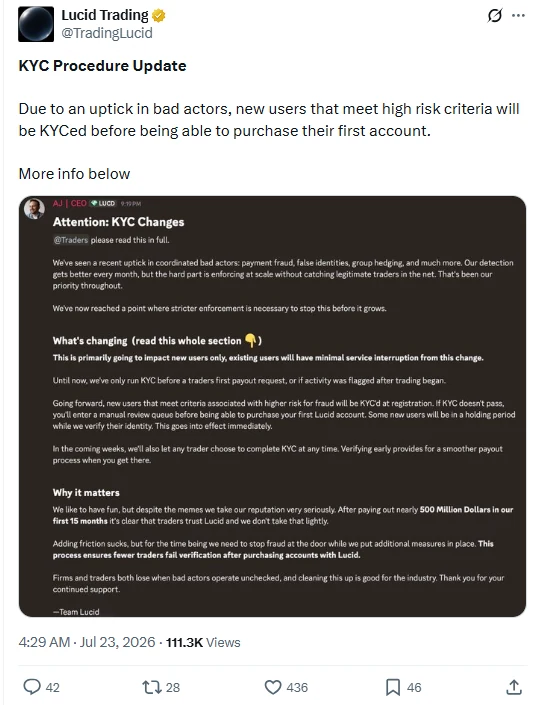
Additional detail on the policy, reported by PropScorer and consistent with Lucid's own framing, describes new registrations identified as high-risk being required to pass KYC before buying an account. If verification fails, the account enters a manual review queue, and some new users may face a short holding period while identity checks are completed. Lucid has also indicated it plans to let any trader complete KYC optionally at any point in the coming weeks, ahead of when it would otherwise be required, which would let traders clear verification before it becomes a bottleneck at payout time.
What is confirmed.
The policy itself, KYC moved to registration for new users meeting high-risk criteria, is confirmed directly from Lucid's own official X statement, posted at 4:29am on 23 July 2026. The statement is attributed to AJ, Lucid's CEO, and names the specific behaviors driving the change: payment fraud, false identities, and group hedging. The manual review queue and holding-period mechanics for failed verification are confirmed in the same statement. Lucid also confirmed, in the CEO's own words, that the firm has paid out nearly $500 million in its first 15 months of operation, a figure previously relayed only through secondary coverage and now directly sourced.
Verifying a firm's stated policies against what traders actually report is exactly the kind of due diligence worth doing before funding an account anywhere. Apex Trader Funding is another established futures firm worth comparing on documented terms, currently running a discount on evaluation fees.
What remains uncertain.
More significant for anyone evaluating the firm: recent Trustpilot reviews describe existing funded traders being caught in Lucid's fraud enforcement process in ways that raise real due-process questions. One review, posted within the past day, describes a trader with over $15,000 in profit and two completed payouts on a funded account whose third payout request triggered an account review, a repeat KYC request, and ultimately a permanent enforcement notice citing only "Fraud," with no identified trade, conduct, or specific policy violation given as the basis. A second review on the same page describes a trader accused of identity fraud over a shared surname with a sibling who separately held their own account, which the trader says they were able to document as legitimate.
We have not independently verified either individual account, and it's worth being precise about what these complaints do and don't show. They aren't necessarily connected to the new registration-stage KYC policy specifically, which applies to new signups rather than existing funded accounts. A separate, independent review of Lucid's complaint history found that most complaints in its broader log relate to false-positive hedging flags, identity-verification friction, and slow support on disputed edge cases, not fraud allegations themselves. Whether the new registration policy reduces or has any relationship to the kind of enforcement described in these reviews is not something either side has addressed.
Why this matters.
A firm tightening verification to keep bad actors out is a reasonable, defensible policy on its own terms, and one that ultimately benefits traders who don't want to compete against manipulated leaderboards or degraded payout reliability caused by fraud elsewhere in the pool. The trade-off is onboarding friction for legitimate new users, which is manageable if the process is fast, risk-based, and transparent.
The separate question, how Lucid's fraud enforcement is experienced by traders already funded, matters independently of whether this specific policy change is a good one. A "Fraud" label applied without any specific stated basis is difficult for an affected trader to contest, and difficult for an outside observer to evaluate at all. That's a distinct concern from whether new-user KYC timing is sensible, and both are worth tracking.
What happens next.
We will update this piece if Lucid publishes further detail on its enforcement process, addresses the complaints referenced above, or if the optional early-KYC option Lucid has previewed becomes available.
If you're comparing futures firms on documented rules and enforcement clarity, our full Apex Trader Funding review breaks down terms in one place.
Questions, answered.
Sources
- Lucid Trading, official statement from CEO AJ, @TradingLucid on X, 4:29am, July 23, 2026.
- PropFirmMatch, Lucid Trading Adds Stricter KYC for New Traders, accessed July 2026.
- PropScorer, Lucid Trading Tightens Fraud and KYC Checks for New High-Risk Registrations, accessed July 2026.
- PropScorer, Lucid Trading firm review page, accessed July 2026.
- Trustpilot, Lucid Trading customer reviews, accessed July 2026.
- Phidias Prop Firm, Lucid Trading Explained, educational review, accessed July 2026.